Interactive Kp-Scale

Kp 0-4: Quiet

The aurora is mostly confined to the high latitudes. Activity is low.

Visible in: Tromsø, Alaska, Iceland.

Kp-Index explained

The Kp-index is the standard measure of global geomagnetic activity, ranging from 0 (very quiet) to 9 (extreme geomagnetic storm). While aurora hunters in high latitudes like Iceland can enjoy displays at Kp 2, seeing the Northern Lights in mid-latitudes typically requires a value of Kp 6 or higher. Starting at Kp 7 (G3 storm), the chances increase significantly for the aurora to be visible or captureable via camera in more southern regions.

Solar Wind Dynamics
The Particle's Journey

Solar wind speed is a critical factor in determining the intensity of an aurora. While average solar wind speeds hover around 300–400 km/s, coronal mass ejections (CMEs) can accelerate particles to speeds exceeding 500 to 800 km/s. Faster solar wind leads to a more powerful energy transfer into Earth's magnetosphere, significantly increasing the likelihood of vibrant Northern Lights.

The "Magnetic Door" (Bz)
IMF Connection

A negative Bz value (southward orientation) is crucial. The more negative the value (e.g., -10 nT or lower), the wider Earth's magnetic field opens to incoming solar wind.

Particle Density
The Fuel of Light

Proton density measures the concentration of charged particles within a cubic centimeter of solar plasma. High density (above 10-20 p/cm³) means there is more material available to interact with the gases in our atmosphere. When high density meets high speed, it results in especially bright, dense, and well-structured auroral displays.

Colors & Spectroscopy

The colors of the aurora are created by the collision of solar particles with different gases in our atmosphere. At lower altitudes (around 100 km), nitrogen produces violet or pink fringes. The iconic green aurora is caused by oxygen at altitudes of about 100 to 240 km. At extreme altitudes above 300 km, oxygen in thinner atmospheric layers reacts to produce the rare red aurora, which is often visible during strong geomagnetic storms even in mid-latitudes.

200 km
Lower Atmosphere Exosphere
Oxygen Green
GAS: ATOMIC OXYGEN

Most common color. Produced by oxygen atoms between 100km and 240km.


The Aurora
What is an Aurora?

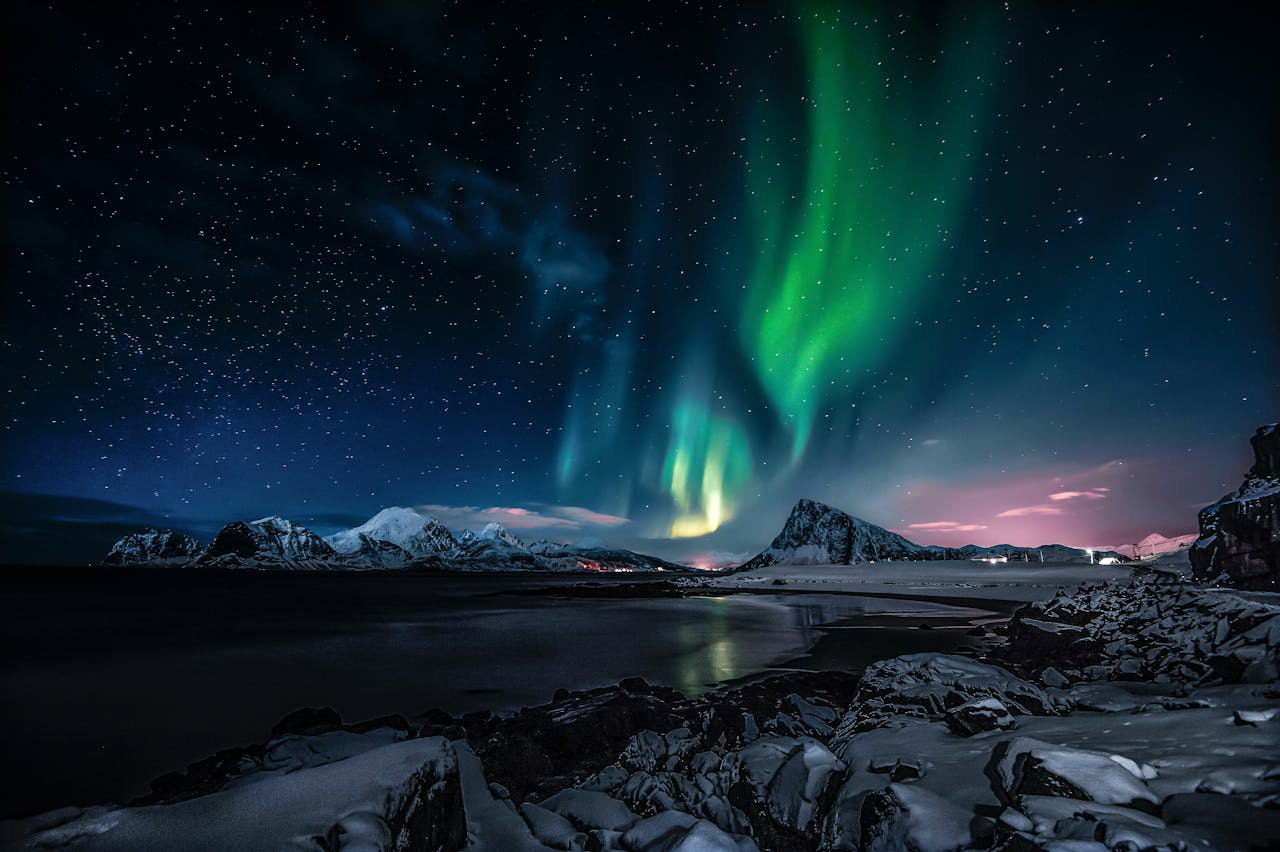
The Aurora Borealis (Northern Lights) and Aurora Australis (Southern Lights) are mesmerizing displays of light that occur when high-speed electrons from space collide with the gases in Earth’s upper atmosphere. While protons can also cause auroras, their displays are typically faint, diffuse, and difficult for the human eye to detect.

The Coronal Holes
Coronal Holes

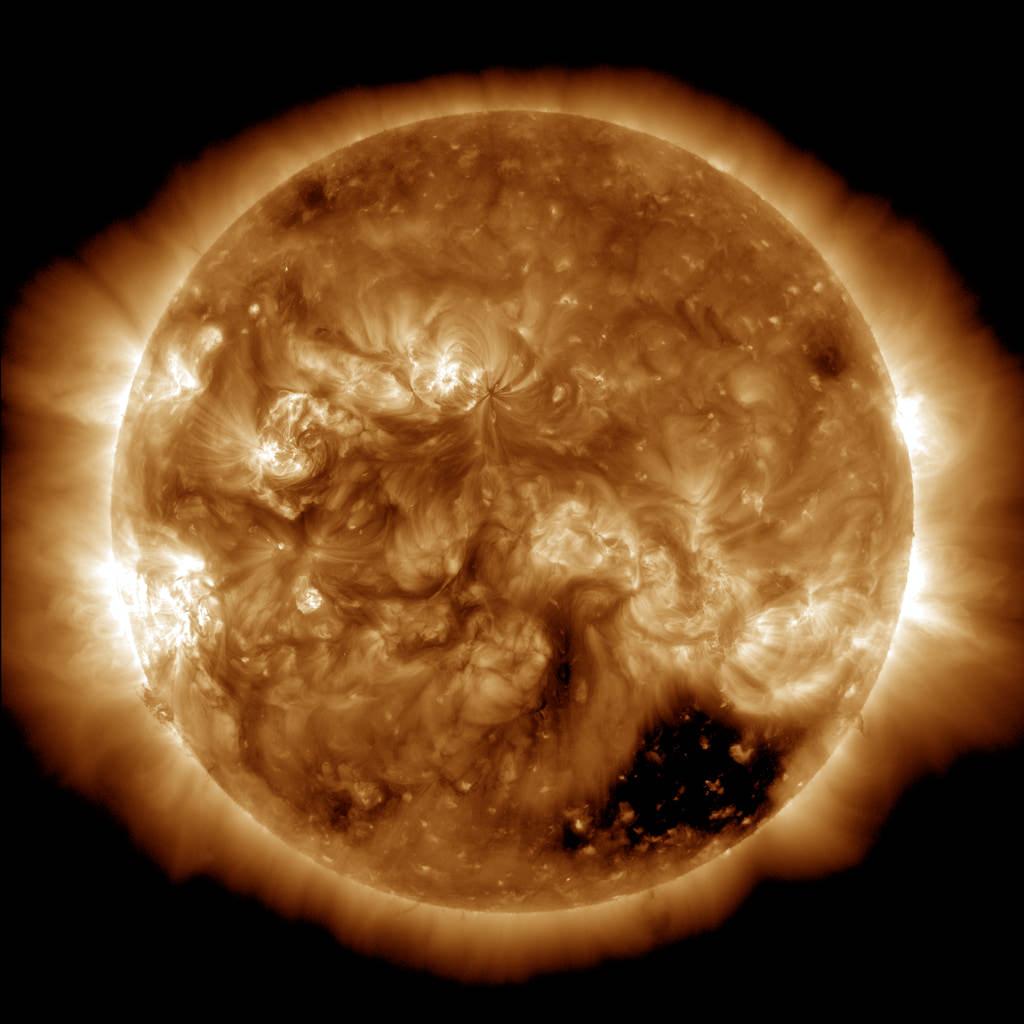
Coronal holes are regions in the Sun’s outer atmosphere (the corona) where the magnetic field is "open" rather than looped. In satellite images—specifically those using Extreme Ultraviolet (EUV) or soft X-rays—these areas appear as dark patches. They look dark because they are significantly cooler and less dense than the surrounding solar plasma.

The Magnetosphere
Magnetosphere

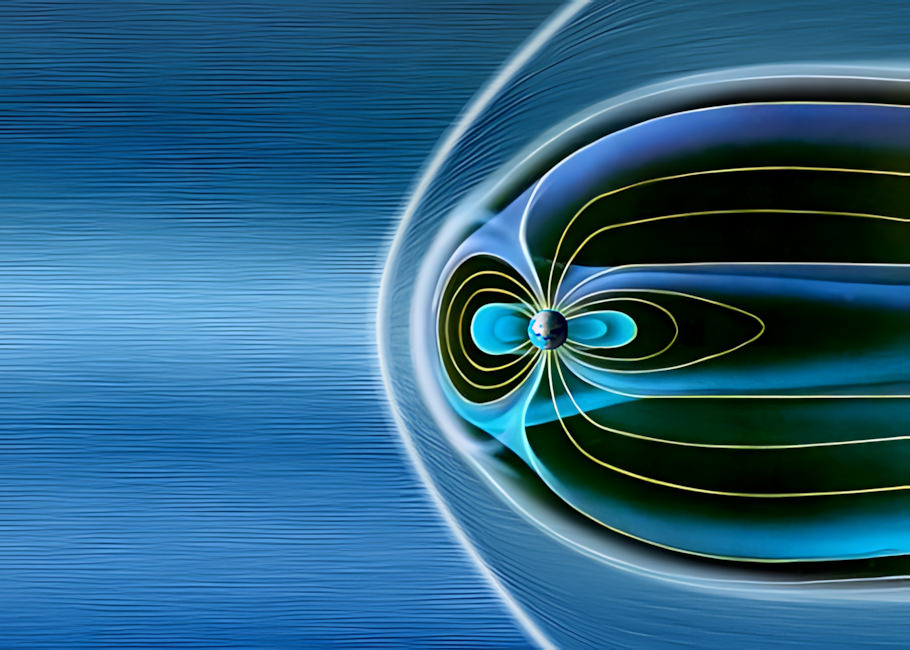
The magnetosphere is a vast region of space surrounding Earth where the planet's magnetic field is the dominant force. It is not a perfect sphere; instead, it is shaped by the constant stream of charged particles flowing from the Sun, known as the solar wind. This region acts as a protective shield, deflecting much of the solar radiation that would otherwise strip away our atmosphere.

Live Aurora View
Abisko Sky Cam

Real-time view from the Aurora Sky Station. Watch the sky dance right now.

Aurora Sky Station
Sky Station

best place on earth to experience northern lights

Aurora Village
Yelloknife

place for visitors to experience the magic and wonder of the North

Frequently Asked Questions (FAQ)
Answers about Kp-Index, Bz value, visibility in Germany, forecasts, photography and more.
Go to FAQ
Northern Lights Photography
Best settings, gear, composition, smartphone tips and post-processing.
Photography Tips
Aurora link collection
discover Aurora on the web

Lights Over Lapland is the world leader in helping guests from all reaches of the globe experience and photograph the magical aurora borealis in Abisko National Park, Sweden. Lights over Lapland

Aurora Village is a place for visitors to experience the magic and wonder of the North. Located on the Ingraham Trail near Yellowknife, in Canada’s Northwest Territories – it is the best place in the world to see the Northern Lights, better known as Aurora Borealis. Come and join us and watch in comfort as the brilliantly beautiful Aurora dance across the northern sky. Aurora Village Canada

SpaceWeatherLive.com is a near live website where you can follow space weather from the Sun to Earth and know exactly when you can see aurora. SpaceWeatherLive

The two maps show the North and South poles of Earth respectively. The brightness and location of the aurora is typically shown as a green oval centered on Earth’s magnetic pole. The green ovals turn red when the aurora is forecasted to be more intense. NOAA Aurora forecast

Find the best dark locations for sky observations. This website gives you a perfect overview for your location or other positions on earth on light pollution and aurora probability. Light Pollution Map

AuroraMAX is a Canadian aurora observatory. By means of a ground camera in Yellowknife, Northwest Territories, you can see the aurora from the comfort of your home. The camera turns on automatically as soon as the Sun sets in Yellowknife during the aurora season. The countdown timer shows how much time is left until the broadcast starts. Auroramax Yelloknife Canada

A very nice blog post by Marina Zeiler about the aurora event in January, when we were able to marvel at the Northern Lights not only in Northern Germany but even as far as the Alps. Aurora in Germany